Many overseas buyers face confusion when choosing between ASTM A106 and ASTM A53 pipes because both are carbon steel pipe standards, both are widely used in industrial applications, and both may appear similar in basic quotations. But they are not the same pipe for every project. Choosing ASTM A53 where ASTM A106 is required can create technical rejection, inspection delays, wrong material approval, or performance risk in pressure and high-temperature service.
For EPC contractors, refinery buyers, boiler manufacturers, petrochemical plants, power projects, industrial stockists, fabricators, and overseas procurement teams, the difference between ASTM A106 and ASTM A53 should be understood before placing an order. The decision should not be based only on price or availability. It should be based on application, temperature, pressure, pipe type, grade, schedule, documentation, inspection requirement, and project specification.
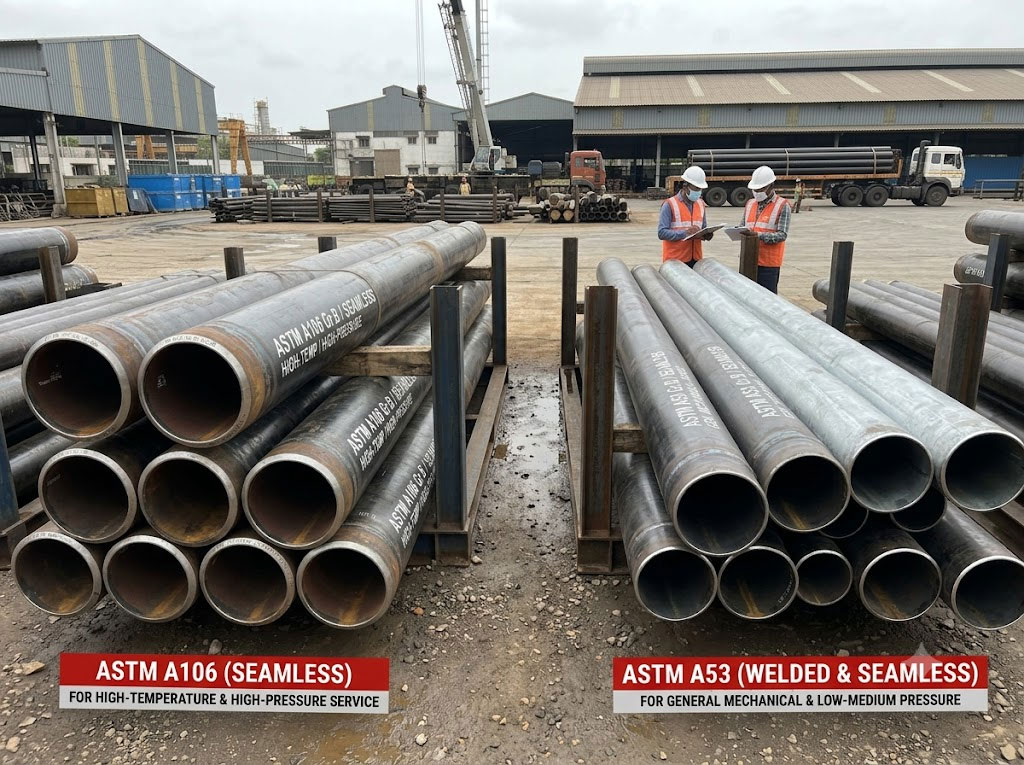
ASTM A106 seamless carbon steel pipes are commonly used for high-temperature service in refineries, boilers, petrochemical plants, process piping, power plants, and industrial pressure lines. ASTM A53 pipes are commonly used in general pressure, mechanical, structural, water, air, steam, and low to moderate industrial applications depending on project approval.
The problem begins when buyers send a general enquiry such as “carbon steel pipe required” without mentioning whether the project needs ASTM A106 or ASTM A53. If the wrong standard is quoted, the buyer may lose time during technical review or receive material that does not match the final application.
Kwality Steelage supplies industrial metal pipes for oil and gas, refinery, petrochemical, power, water transmission, infrastructure, construction, offshore, and process industry applications. With a wide range of ASTM A106, ASTM A53, API 5L, seamless, ERW, LSAW, HSAW, EFW, carbon steel, alloy steel, stainless steel, duplex, and super duplex pipes, Kwality Steelage helps overseas buyers reduce wrong-standard selection risk and source project-specific pipe materials.
The Real Problem: ASTM A106 and ASTM A53 Are Often Compared Only by Price
Many buyers compare ASTM A106 and ASTM A53 pipes because both are carbon steel pipes. In price comparison, ASTM A53 may sometimes look more economical depending on size, grade, type, and availability. But selecting a pipe only because it is cheaper can create problems if the project specification requires ASTM A106.
From a procurement point of view, the buyer should not ask only, “Which pipe is cheaper?” The better question is:
Which standard is approved in the project specification?
Is the application high-temperature service?
Is seamless pipe mandatory?
What pressure and temperature conditions are involved?
Is the pipe for boiler, refinery, process, structural, water, or general service?
What documents and tests are required?
Will the material pass inspection?
If the project specification mentions ASTM A106, ASTM A53 should not be supplied as an alternate unless the buyer’s engineering team approves it.
Quick Difference Between ASTM A106 and ASTM A53 Pipes
| Comparison Point | ASTM A106 Pipe | ASTM A53 Pipe |
|---|---|---|
| Main Use | High-temperature carbon steel service | General pressure, mechanical and structural applications |
| Common Pipe Type | Seamless | Seamless or welded depending on type |
| Typical Industries | Refinery, boiler, petrochemical, power, process piping | Water, steam, air, structural, general industrial service |
| Temperature Suitability | Preferred for high-temperature service | Not generally selected for the same high-temperature critical service as A106 |
| Buying Risk | Wrong grade or schedule can affect pressure service | Wrong substitution for A106 can cause technical rejection |
| Procurement Focus | Grade, schedule, MTC, pressure/temperature service | Type, grade, application approval, dimensions |
| Export Buyer Concern | Technical approval and certification | Suitability for intended general service |
ASTM A106 Pipe: When Buyers Usually Need It
ASTM A106 pipe is commonly selected when the project requires seamless carbon steel pipe for high-temperature service. It is widely used in applications where pressure, temperature, and process reliability matter.
Export buyers often ask for ASTM A106 Grade B because it is one of the most common grades used in industrial pressure and high-temperature piping. However, buyers still need to confirm grade, size, schedule, quantity, testing, MTC, inspection, and end finish before placing an order.
ASTM A106 pipes may be used in:
Boiler lines
Refinery process piping
Petrochemical plants
Power plants
Steam lines
High-temperature process lines
Heat exchanger systems
Industrial pressure piping
Oil and gas facilities
Maintenance and shutdown projects
ASTM A106 is usually preferred when the application demands seamless construction and high-temperature performance.
If your project requires ASTM A106 Grade B seamless pipes, share your size, schedule, quantity, testing requirement, and delivery timeline with Kwality Steelage for quotation support.
ASTM A53 Pipe: When Buyers Usually Need It
ASTM A53 pipes are commonly used for general pressure, mechanical, structural, water, air, steam, and lower to moderate service applications depending on the project requirement. ASTM A53 can be supplied in seamless or welded form depending on type and requirement.
ASTM A53 may be used in:
General industrial piping
Water lines
Air lines
Steam service, where permitted by specification
Structural applications
Mechanical systems
Fabrication work
Low to moderate pressure service
Non-critical plant piping
Utility piping
ASTM A53 can be suitable where the project specification allows it. But it should not automatically replace ASTM A106 in high-temperature or critical pressure applications.
Common Buyer Mistakes in ASTM A106 vs ASTM A53 Selection
| Buyer Mistake | What It Can Cause | Better Approach |
|---|---|---|
| Asking only for “carbon steel pipe” | Supplier may quote wrong standard | Mention ASTM A106 or ASTM A53 clearly |
| Choosing A53 only because it is cheaper | Technical rejection if A106 is required | Follow project specification |
| Not mentioning seamless or welded type | Wrong pipe type quotation | Confirm pipe type at enquiry stage |
| Missing schedule or wall thickness | Incorrect price and pressure suitability | Share schedule or wall thickness |
| Not checking temperature condition | Wrong pipe selection | Mention application and service temperature |
| Accepting alternate material casually | Project approval risk | Get engineering approval before substitution |
| Not reviewing MTC | Inspection hold | Review documents before dispatch |
| Not planning inspection | Shipment delay | Confirm inspection scope early |
Why High-Temperature Service Changes the Decision
Temperature is one of the most important factors in choosing between ASTM A106 and ASTM A53. ASTM A106 is commonly preferred for high-temperature service, especially in refineries, boilers, power plants, petrochemical lines, and process piping.
If a buyer selects ASTM A53 only because it is available or cheaper, the material may not meet the intended service requirement. This can create technical rejection during project document review.
For high-temperature applications, buyers should check:
Project pipe class
Operating temperature
Operating pressure
Fluid or media
Grade requirement
Pipe type requirement
Schedule or wall thickness
Testing requirement
Approved standard
Inspection condition
A pipe that looks similar physically may not be acceptable for the service condition.
Seamless vs Welded Requirement Must Be Clear
Another major difference in buying is pipe type. ASTM A106 is generally associated with seamless carbon steel pipe. ASTM A53 can be available in seamless and welded forms depending on type.
If the project specification requires seamless pipe, the buyer must mention this clearly. A welded pipe should not be supplied against a seamless requirement unless approved.
| Requirement | Buyer Should Confirm |
|---|---|
| Seamless pipe mandatory | Mention seamless in enquiry and PO |
| Welded pipe acceptable | Confirm type and project approval |
| ERW pipe allowed | Check specification and inspection requirement |
| High-pressure service | Confirm grade, schedule and testing |
| High-temperature service | Review standard and material suitability |
For export buyers, unclear pipe type can create revised quotations and approval delays.
Grade and Schedule Are Equally Important
Even after selecting the right standard, buyers must confirm grade and schedule. ASTM A106 Grade B in the wrong schedule may still be unsuitable for the project. ASTM A53 in the wrong type or grade may also create approval issues.
A complete enquiry should include:
Standard
Grade
Pipe type
NPS or OD
Schedule or wall thickness
Quantity
Length
End finish
Application
Testing requirement
MTC requirement
Inspection requirement
Packing requirement
Destination port
Delivery timeline
This helps the supplier quote accurately and reduces technical confusion.
MTC and Traceability Help Prove the Correct Standard
Material Test Certificate is important in both ASTM A106 and ASTM A53 pipe supply. It helps verify grade, standard, heat number, chemical composition, mechanical properties, testing, and compliance with the purchase order.
Buyers should review the MTC before dispatch, especially when the project specification is strict.
MTC review should confirm:
Correct standard
Correct grade
Heat number
Chemical composition
Mechanical properties
Pipe size
Testing details
Material traceability
Compliance with PO
If the MTC does not match the purchase order, the shipment may be held or rejected.
Third-Party Inspection May Be Needed for Project Orders
For export project supply, many buyers require third-party inspection before shipment. Inspection agencies may verify pipe dimensions, marking, MTC, heat number traceability, surface condition, quantity, packing, and compliance.
This is especially important when the buyer is importing material for refinery, power, petrochemical, oil and gas, EPC, or government-related projects.
Buyers should confirm inspection requirements early:
Inspection agency
Inspection scope
Document review
Dimensional check
Quantity check
Marking verification
Packing inspection
Dispatch clearance
Inspection planning should not be left until the shipment is ready.
Export Packing and Marking Should Match the Standard
ASTM A106 and ASTM A53 pipes may be supplied in different sizes, schedules, and quantities. For export shipments, packing and marking must be clear to avoid site confusion.
Good export packing should support:
Material protection
End protection
Rust prevention
Clear grade marking
Heat number visibility
Size-wise identification
Packing list accuracy
Safe handling
Shipment traceability
For mixed orders, marking is especially important because ASTM A106 and ASTM A53 should not be mixed or confused at the destination.
Cost Comparison: Cheap Pipe vs Correct Pipe
The cheaper pipe is not always the better pipe. If ASTM A53 is quoted against an ASTM A106 requirement, the buyer may save money at first but lose more through technical rejection, re-sourcing, delayed installation, inspection cost, and project downtime.
| Buying Approach | Short-Term Result | Long-Term Risk |
|---|---|---|
| Choose cheapest pipe | Lower initial quote | Higher chance of mismatch |
| Follow project standard | Correct technical supply | Lower rejection risk |
| Review MTC before dispatch | Better control | Fewer approval delays |
| Confirm schedule and type | Accurate quotation | Fewer site issues |
| Use reliable supplier | Better coordination | Lower procurement risk |
For industrial buyers, the correct pipe is usually more economical than the cheapest wrong pipe.
ASTM A106 vs ASTM A53 Selection Checklist
| Question | Why It Matters |
|---|---|
| What does the project specification mention? | Final material should match approved standard |
| Is the application high-temperature service? | ASTM A106 may be required |
| Is seamless pipe mandatory? | Affects pipe type selection |
| What grade is required? | Prevents wrong material supply |
| What schedule is required? | Confirms wall thickness and pressure suitability |
| Is third-party inspection required? | Affects dispatch planning |
| Is MTC required before shipment? | Supports approval and traceability |
| Is export packing required? | Protects material during shipment |
| Is alternate material allowed? | Must be approved before order |
ASTM A106 and ASTM A53 Pipe Enquiry Checklist for Export Buyers
| Detail Required | Why It Matters |
|---|---|
| Standard | Confirms ASTM A106 or ASTM A53 requirement |
| Grade | Prevents wrong material selection |
| Pipe type | Confirms seamless or welded requirement |
| Size / NPS / OD | Identifies pipe dimension |
| Schedule / wall thickness | Confirms pressure and weight |
| Quantity | Helps stock and shipment planning |
| Length | Affects availability and packing |
| Application | Helps identify correct standard |
| MTC requirement | Confirms traceability |
| Inspection requirement | Supports project approval |
| End finish | Helps installation planning |
| Packing requirement | Protects material during export |
| Destination port | Supports logistics planning |
| Delivery timeline | Helps confirm feasibility |
A complete enquiry helps Kwality Steelage provide accurate quotation and reduce wrong-standard selection risk.
Why Kwality Steelage Supports Carbon Steel Pipe Export Buyers
Kwality Steelage supplies carbon steel and industrial metal pipes for overseas buyers who need correct grade, documentation, inspection coordination, export packing, and dispatch support.
As a supplier, wholesaler, stockist, and exporter, Kwality Steelage supports buyers with project-specific pipe supply across oil and gas, refinery, petrochemical, power, infrastructure, water transmission, construction, offshore, and process industry applications.
The company can support requirements for:
ASTM A106 pipes
ASTM A53 pipes
Carbon steel seamless pipes
API 5L pipes
ERW pipes
LSAW pipes
HSAW pipes
EFW pipes
Alloy steel pipes
Stainless steel pipes
Duplex and super duplex pipes
For overseas buyers, Kwality Steelage helps simplify sourcing by supporting grade-wise supply, MTC documentation, inspection readiness, export packing, and shipment planning.
When Should You Contact Kwality Steelage?
You should contact Kwality Steelage when your carbon steel pipe requirement involves ASTM A106, ASTM A53, seamless pipe, welded pipe, project inspection, MTC, urgent delivery, export packing, or technical selection support.
Buyers can share:
Standard
Grade
Pipe type
Size
Schedule or wall thickness
Quantity
Length
Application
MTC requirement
Inspection requirement
Packing requirement
Destination port
Delivery timeline
With these details, Kwality Steelage can provide more accurate quotation and help reduce procurement risk.
Conclusion
ASTM A106 and ASTM A53 pipes are both carbon steel pipe standards, but they should not be selected casually or used interchangeably without project approval. ASTM A106 is commonly selected for high-temperature seamless carbon steel service, while ASTM A53 is often used for general pressure, mechanical, structural, utility, and lower to moderate service applications where permitted.
Export buyers should choose based on project specification, application, pipe type, grade, schedule, testing, MTC, inspection, and documentation requirement—not only price.
The safest approach is to work with an experienced carbon steel pipe supplier, wholesaler, stockist, and exporter who understands export procurement and technical documentation.
Kwality Steelage supports overseas buyers with ASTM A106, ASTM A53, API 5L, seamless, ERW, LSAW, HSAW, EFW, carbon steel, alloy steel, stainless steel, duplex, and super duplex pipe supply for industrial and project requirements.
For carbon steel pipe enquiries, share your standard, grade, size, schedule, quantity, inspection requirement, and delivery timeline with Kwality Steelage to receive a project-focused quotation.
FAQs
What is the main difference between ASTM A106 and ASTM A53 pipes?
ASTM A106 pipes are commonly used for high-temperature seamless carbon steel service, while ASTM A53 pipes are commonly used for general pressure, mechanical, structural, water, steam, and utility applications where approved.
Can ASTM A53 replace ASTM A106?
ASTM A53 should not replace ASTM A106 unless the project engineer, client, or specification allows it. They are not automatically interchangeable.
When should buyers choose ASTM A106 pipe?
Buyers should choose ASTM A106 pipe when the project requires seamless carbon steel pipe for high-temperature service, such as boiler, refinery, petrochemical, process, or power plant applications.
When should buyers choose ASTM A53 pipe?
Buyers may choose ASTM A53 pipe for general pressure, mechanical, structural, water, air, steam, utility, and lower to moderate service applications where the project specification allows it.
Is ASTM A106 pipe seamless?
ASTM A106 is generally associated with seamless carbon steel pipe for high-temperature service.
Is ASTM A53 pipe seamless or welded?
ASTM A53 pipe can be supplied in seamless or welded form depending on type and project requirement.
Why is schedule important in ASTM A106 and ASTM A53 pipe buying?
Schedule indicates wall thickness. It affects pressure suitability, weight, price, availability, packing, and freight.
Why should buyers mention application in the enquiry?
Application helps the supplier understand whether the pipe is for high-temperature, pressure, structural, utility, process, or general service, reducing wrong-standard selection risk.
Why is MTC important for ASTM pipe buyers?
MTC confirms standard, grade, chemical composition, mechanical properties, heat number, testing, and compliance with the purchase order.
Can ASTM A106 and ASTM A53 pipes be inspected before shipment?
Yes. Both can be inspected before shipment by buyer-appointed or third-party inspection agencies depending on project requirements.
What causes delays in ASTM A106 vs ASTM A53 pipe procurement?
Delays happen due to unclear standard, missing grade, missing schedule, wrong pipe type, incomplete MTC, late inspection planning, or unapproved substitution.
Should buyers choose ASTM A53 only because it is cheaper?
No. Buyers should not choose ASTM A53 only because it is cheaper if the project requires ASTM A106. The correct standard must match the project specification.
Can Kwality Steelage supply ASTM A106 and ASTM A53 pipes?
Yes. Kwality Steelage supplies ASTM A106, ASTM A53, carbon steel, seamless, welded, API 5L, and other industrial metal pipes for export buyers.
What details should buyers share for ASTM A106 or ASTM A53 quotation?
Buyers should share standard, grade, pipe type, size, schedule, quantity, length, application, MTC requirement, inspection requirement, packing requirement, destination port, and delivery timeline.
How can buyers avoid wrong ASTM pipe selection?
Buyers can avoid wrong selection by following project specification, confirming standard and grade, sharing complete technical details, reviewing MTC, and avoiding unapproved substitutions.